Let’s be real: most of us have a complicated relationship with saving money. I used to be the person who would check my bank account on a Tuesday, feel like a financial wizard, and then wonder where it all went by Friday. I’d heard about Acorns for years, but I always thought, “How much can spare change really do?”
I finally decided to stop wondering and actually put my literal pennies where my mouth is. I’ve been using Acorns for the last six months, linking it to my primary debit card and my chaotic spending habits. If you’re asking yourself, “Is Acorn worth it?” or if it’s just another app cluttering your phone, here is my unfiltered experience.
The First Impression: Setting Up My “Spare Change” Empire
When I first downloaded the app, I expected a mountain of paperwork—or at least the digital equivalent. Instead, the onboarding was surprisingly slick. The app asks about your financial goals and risk tolerance. Since I’m in my late 20s and have a bit of a “set it and forget it” mindset, I opted for the “Aggressive” portfolio. Don’t let the name scare you; it just means a higher percentage of stocks (ETFs) versus bonds.
The unboxing experience of the app itself is clean. There’s no clutter. However, the first “real” moment happened when I linked my bank account. There’s a slight pang of anxiety when you give an app access to your transaction history, but seeing the first “Round-Up” happen was oddly satisfying. I bought a coffee for $4.35, and Acorns quietly tucked away $0.65. It felt like finding a dollar in an old pair of jeans, but intentional.
Living with Acorns: The Day-to-Day Reality
I’ll be honest: for the first two weeks, I forgot I even had the app. That is actually the highest compliment I can pay a financial tool. It operates in the background of your life.
The “Ouch” Factor
About a month in, I noticed something. Because I’m a high-volume shopper (lots of small trips to the grocery store, gas station, and Target), my Round-Ups were totaling about $60 to $80 a month. While that’s great for my savings, if you’re living paycheck to paycheck, you will feel that extra $80 leaving your checking account. I had one week where my balance was lower than expected because a batch of Round-Ups hit right before my payday.
Pro Tip: You can set Round-Ups to “Manual” if you want to approve them first, but that honestly defeats the purpose of the app’s “autopilot” charm.
The Sensory Experience (Yes, Really)
There is a specific “ping” notification you get when you hit a milestone or when a “Found Money” bonus kicks in. It’s a hit of dopamine. I also ordered the Acorns Tungsten Metal Debit Card (available with the higher-tier plans). It has a heavy, premium weight to it that feels significantly more “expensive” than my flimsy plastic bank card. Does it make the money grow faster? No. Does it feel cool when you drop it on a table? Absolutely.
Encountering Glitches
It wasn’t all smooth sailing. About three months in, my bank changed its security protocol, and my Round-Ups stopped syncing. The app didn’t notify me immediately; I only noticed when my “Invested” total hadn’t moved in a week. Re-linking the account was a bit of a chore involving two-factor authentication loops. It’s a reminder that these “set it and forget it” apps still need a weekly check-in.
Real-World Performance: Expectations vs. Reality
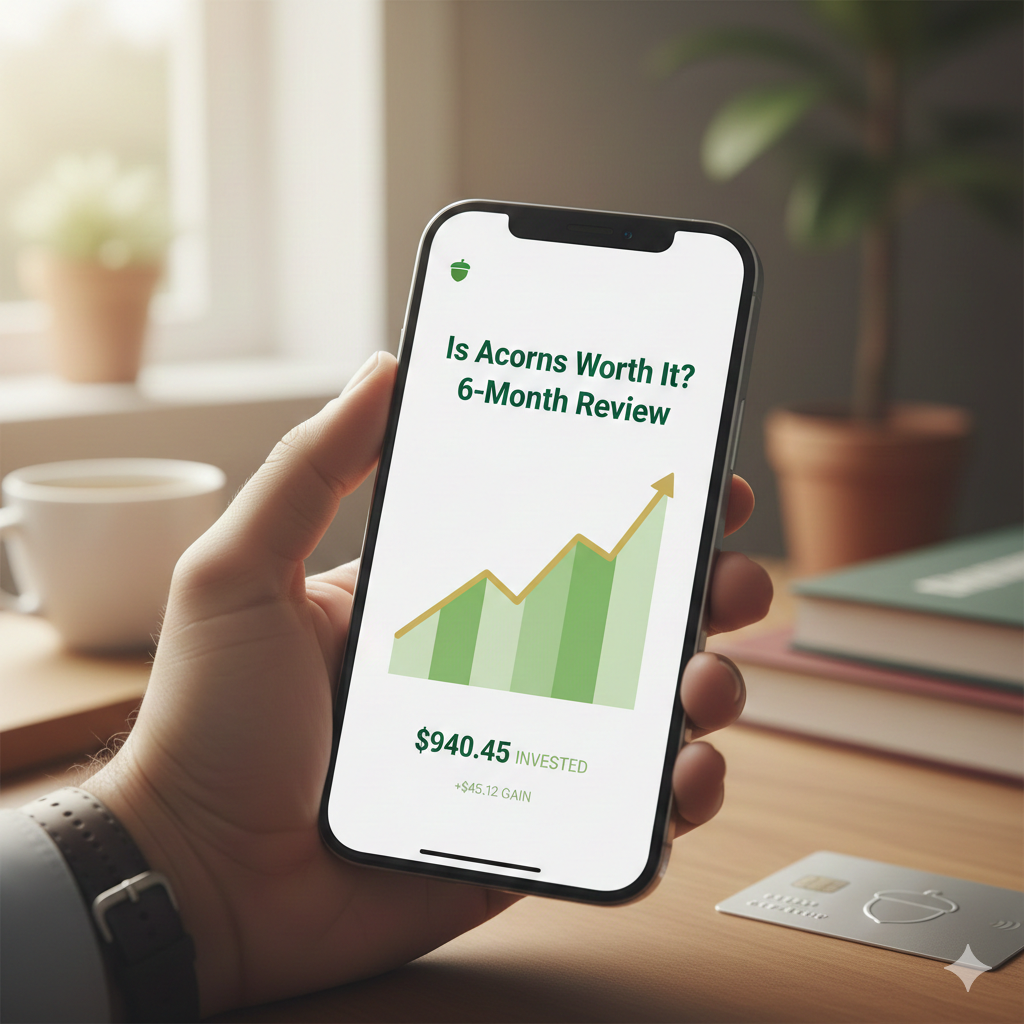
People often ask, “Can you actually get rich on Acorns?” In six months, my Round-Ups plus a small $20 weekly recurring investment have grown to about $940. Out of that, about $45 is pure market gain.
Is $45 going to fund my retirement? No. But here’s the comparison: that same money would have been sitting in my traditional savings account earning maybe $0.50 in interest, or more likely, it would have been spent on takeout.
Comparisons with Alternatives
I’ve tried Robinhood and Betterment as well.
-
Robinhood is for when I want to feel like a “trader” and pick specific stocks (which usually leads to me losing money).
-
Betterment feels more like a “grown-up” investment firm for large sums.
-
Acorns occupies this unique space of “passive accumulation.” It’s the only app that changed my behavior without me having to exert willpower.
The Good, The Bad, and The Monthly Fee
When weighing if Acorns is worth it, you have to look at the math that the marketing hides.
The Highlights (The Good)
-
The “Found Money” Feature: This is underrated. I bought a pair of sneakers from a partner brand, and they deposited $10 into my investment account. It’s like cash-back but for your future self.
-
Educational Content: The “Grow” magazine articles in the app are actually readable. They aren’t dry; they explain things like inflation and ETFs in a way that doesn’t make my eyes glaze over.
-
Multiplier Effect: You can set your Round-Ups to 2x or 3x. When I did this for a month, my savings exploded, though my “fun money” for the weekends took a hit.
The Real-World Cons (The Bad)
-
The Subscription Fee: This is the biggest hurdle. The tiers usually start at $3/month. If you only have $100 in the account, a $3 fee is essentially a 3% monthly tax on your wealth. That is huge in the investment world. You really need to be investing at least $100+ a month to make the fee mathematically better than a free brokerage.
-
The “Wait Time”: Moving money out of Acorns isn’t instant. It takes 3-5 business days. If you have an emergency and need that cash now, you’re out of luck.
Final Verdict: Is Acorn Worth It?
After half a year of usage, here is my honest recommendation:
Acorns is worth it if: You are a “spender” who struggles to save. The psychological benefit of seeing $900 in an account that you “didn’t miss” from your budget is worth the $3 monthly fee. It’s a gateway drug to better financial habits.
Acorns is NOT worth it if: You already have a disciplined budget and you’re looking for the lowest possible fees. If you can manually transfer $200 a month into a Vanguard index fund, do that instead. You’ll save on the subscription cost and have more control.
My Personal Choice: I’m keeping it. Not because it’s the most efficient way to invest, but because it’s the most painless. I’ve turned my mindless consumption into a slow-growing nest egg, and for me, that peace of mind is worth the price of a fancy coffee once a month.
Would you like me to compare the different Acorns subscription tiers to see which one fits your spending habits best?
