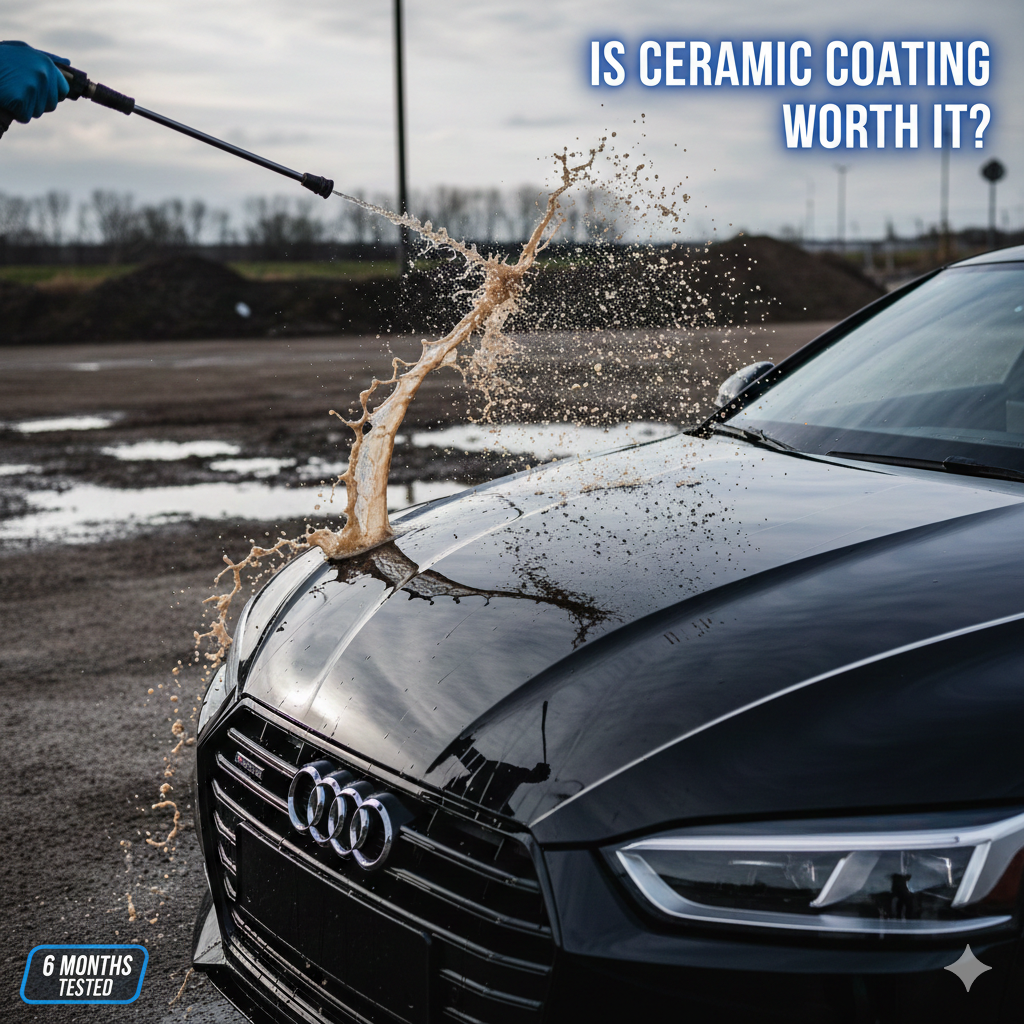
I remember standing in my driveway last March, staring at the swirl marks on my black sedan and wondering if I was about to throw $1,200 down the drain. Like most car enthusiasts, I’d seen the “magic” videos online—the ones where someone pours a bucket of muddy water over a hood and it beads off like mercury, leaving the paint bone-dry.
It looks like sorcery, but as someone who has spent years waxing and polishing by hand, I was skeptical. I finally pulled the trigger on a professional-grade 9H ceramic coating to see if it lived up to the hype. After half a year of daily driving through construction zones and unpredictable weather, I have the answer to the burning question: is ceramic coating worth it?
The “Day One” Reality Check: Expectations vs. First Impressions
When I first picked up the car, the visual difference was staggering. It wasn’t just “clean”; it looked like the car had been dipped in liquid glass. The depth of the black paint felt three-dimensional. However, the first thing the detailer told me was a bucket of cold water to my face: “This isn’t a force field. You can still scratch it, and you still have to wash it.”
That’s the first misconception I had to unlearn. Many people think ceramic coating means you never have to touch your car again. In reality, the coating is a semi-permanent chemical polymer (usually Silicon Dioxide, $SiO_2$) that bonds to your clear coat.
During the first week, I found myself obsessively checking for dust. The tactile sensation was different too—the paint felt incredibly slick, almost oily to the touch, though it was perfectly dry. But the real test started when the honeymoon phase ended and the “real world” hit.
Living With It: The 400-Mile Weekly Grind
The “Self-Cleaning” Myth
Let’s get one thing straight: your car will still get dirty. However, the way it gets dirty has changed my entire Sunday routine.
Last month, I got caught in a heavy downpour on a highway currently under construction. Usually, this results in a thick, gritty film of grey road grime that bonds to the side panels like cement. With the ceramic coating, I noticed something fascinating while driving: the water didn’t just sit there; it flew off the car in massive globes.
When I got home, the car was still dirty, but the grime wasn’t “stuck.” A simple high-pressure rinse at the local bay removed about 80% of the surface dirt without me even picking up a wash mitt. This is where the value starts to show. I used to spend two hours on a full contact wash; now, I’m done in 30 minutes because the dirt has nothing to grip onto.
The Bird Dropping Incident
If you’ve ever had a bird “gift” your car on a hot 95-degree day, you know the panic. The acidity can etch into your clear coat in hours. I had a massive seagull dropping sit on my hood for three days while I was traveling. My heart sank when I saw it.
I took a damp microfiber cloth, and it literally slid off with one light wipe. No scrubbing, no “ghost” mark left behind, and no permanent etching. That single moment saved me a paint correction bill and was the first time I whispered to myself, “Okay, this might be worth the money.”
The Learning Curve (And the Mistakes)
It hasn’t been all sunshine. I learned the hard way that you cannot take a ceramic-coated car through a standard “soft-touch” automated car wash. Those heavy, swirling brushes are filled with grit from the truck that went through before you. Even with the coating, those brushes will leave micro-marring. To keep the coating “healing” and hydrophobic, I had to switch to a two-bucket hand wash method using pH-neutral soap. If you aren’t willing to change how you wash your car, a coating is a waste of your money.
The Highlights: The Good, The Bad, and The Annoying
What I Loved (The Pros)
-
The “Pop”: Even when the car is slightly dusty, the gloss level is higher than a freshly waxed car. It consistently looks like it just came out of a showroom.
-
Hydrophobic Properties: Watching water $H_2O$ bead up into perfect spheres and roll off at 35 mph is incredibly satisfying and keeps the car cleaner for longer.
-
Chemical Resistance: Tree sap and bug guts—the natural enemies of paint—simply don’t bond. I used to need a clay bar for the front bumper every month; I haven’t used one since the coating.
What Frustrated Me (The Cons)
-
Water Spotting: This is the “hidden” downside no one tells you. While the coating repels water, if hard tap water dries on the surface, the minerals bond very strongly to the coating. I found that I have to be much more diligent about drying the car immediately with a leaf blower or a plush towel.
-
The Price Point: Paying $1,000 to $1,500 upfront is a bitter pill to swallow when a $20 bottle of wax exists.
-
Sensitivity to Friction: It is not a “chip guard.” I still got a small stone chip on my highway commute. For physical impact protection, you need Paint Protection Film (PPF), not a coating.
The Verdict: Is It Actually Worth It?
After six months of living with it, my answer depends entirely on who you are.
You should get a ceramic coating if:
-
You plan on keeping your car for more than 3 years.
-
You enjoy washing your car but want the process to be faster and easier.
-
You care deeply about the “depth” and shine of your paint.
-
You want to preserve the resale value by preventing oxidation and light chemical etching.
You should skip it if:
-
You use automated “brush” car washes regularly.
-
You view a car purely as a tool to get from A to B and don’t care about swirls.
-
You are looking for protection against rock chips (save your money for PPF instead).
Final Thoughts
For me, the ceramic coating is worth it because of the time saved. I no longer spend my Saturdays stripping old wax and reapplying sealants. My car looks better than 99% of the vehicles in the parking lot with half the effort. It’s not “set it and forget it,” but it is the closest thing to a permanent “freshly waxed” look that exists in the automotive world today.
If you’re on the fence, start with a high-quality “Ceramic Spray” (the DIY versions). It’ll give you a 15% taste of what the real pro-grade stuff feels like. But if you want that permanent glass-bowl look, find a reputable detailer and go for the real deal. Your future self—and your car’s resale value—will thank you.
Would you like me to create a maintenance guide for ceramic-coated cars or perhaps a comparison between the top 3 DIY ceramic coating kits?
